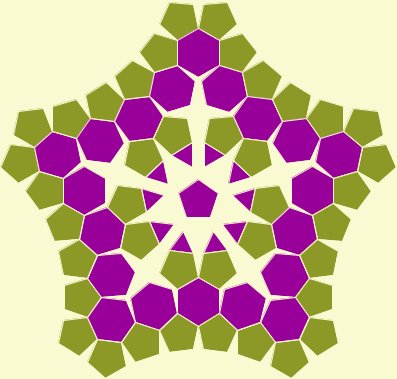
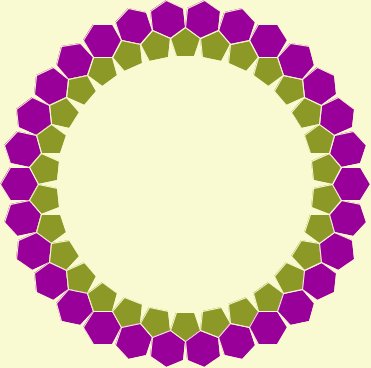
 I guess that I've been a bit obsessed with pentagons and triangles recently. This is mostly an alternating pattern but has a couple of hexagons and triangles. I guess I like this one because of the central curved pentagon. I wish I was able to find a better way to fill the inside of the outer loop...
Saturday, August 12, 2006
I guess that I've been a bit obsessed with pentagons and triangles recently. This is mostly an alternating pattern but has a couple of hexagons and triangles. I guess I like this one because of the central curved pentagon. I wish I was able to find a better way to fill the inside of the outer loop...


Friday, August 11, 2006
Thursday, August 10, 2006


Wednesday, August 09, 2006
 Sunflower
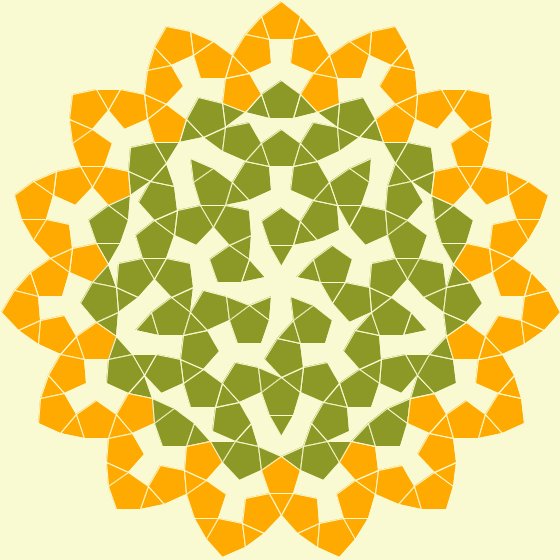
This pattern of a sunflower was a bit tricky to construct. The outer orange section (the petals) was easy given the high level of repetition but filling the insides (the seeds) was not straight forward. The pattern is built with alternating pentagons and triangles. The five-fold symmetry is present throughout the pattern.
Tuesday, August 08, 2006
 This pattern is like the August first pattern: orange nonagons are used instead of heptagons. There are four more nonagons eight more triangles. The pattern arises from wiggly loop of nonagons that have been interlaced with a straight line of triangles. The inner and outer triangles that decorate the pattern help bring out its nine-fold symmetry.
Monday, August 07, 2006
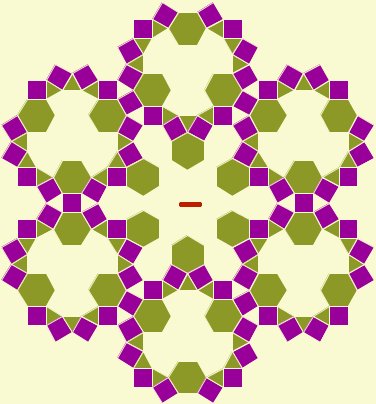 This pattern came about by elaborating a loop of interleaved triangles and squares. Each of the six loops on the outside of the central hub comes of a loop of squares and triangles where three of the triangles have been replaced with hexagons. The hexagons introduces spaces in the loops so that they can easily be connected (with squares) to one another while maintaining the original angles of the replaced triangles. As well, there are additional hexagons put in the central hub to make the negative space more eye catching.
Sunday, August 06, 2006
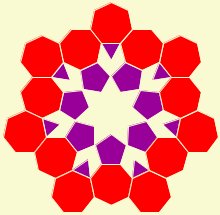
This pattern applies the concept of a five point star to heptagons. The five point star

can be constructed with a pentagon path that alternates a small turns to the right followed by a larger turns to the left. For heptagons, there are fourteen polygons instead ten. As well, the purple triangles and pentagons are added to the loop fourteen heptagons for decoration. I think that these extra polygons help bring out the symmetry.
Subscribe to:
Posts (Atom)
Popular Posts
-
Here's my take on Gödel, Escher, Bach cover in an attempt to start my new class, DATA ANALYTICS: PRINCIPLES & TOOLS. These were ...
-
 This one was fun to make. I wanted a cool snowflake to be a backdrop for a presentation (http://prezi.com/jie04ey9bhjr/zulo/) that I wa...
 -
Unlike normal, I was able to deliver the square version of the descending pentagons quickly. There was no math to figure out. although ...

