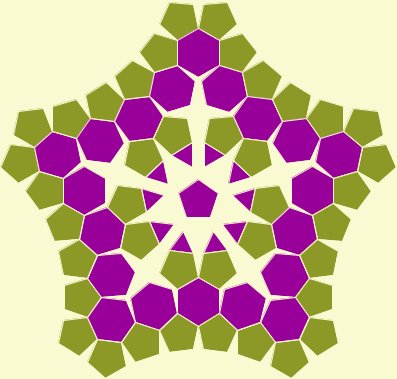
 Here's a little play with hexagons and pentagons. Basically, the outside loop comes from this big loop below. The rest is mere decoration. The pentagon in the middle was difficult to place(and may not be at the theoretical centre).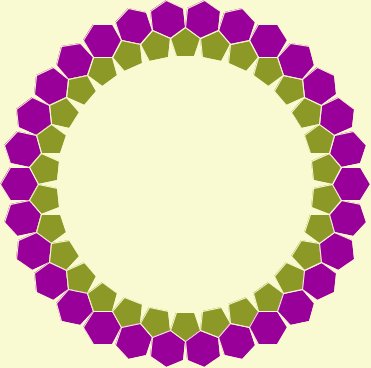
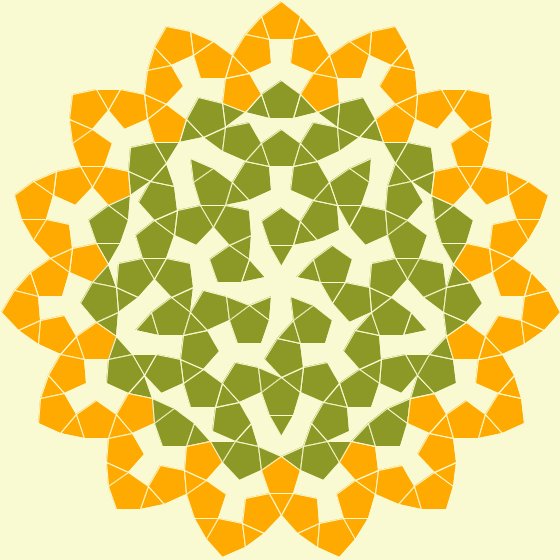 Sunflower
 This pattern is like the August first pattern: orange nonagons are used instead of heptagons. There are four more nonagons eight more triangles. The pattern arises from wiggly loop of nonagons that have been interlaced with a straight line of triangles. The inner and outer triangles that decorate the pattern help bring out its nine-fold symmetry.
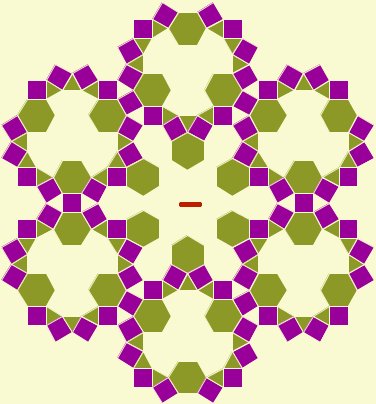 This pattern came about by elaborating a loop of interleaved triangles and squares. Each of the six loops on the outside of the central hub comes of a loop of squares and triangles where three of the triangles have been replaced with hexagons. The hexagons introduces spaces in the loops so that they can easily be connected (with squares) to one another while maintaining the original angles of the replaced triangles. As well, there are additional hexagons put in the central hub to make the negative space more eye catching.
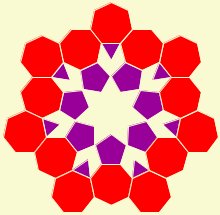

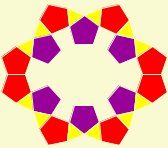
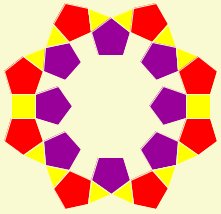 Here's another unravelled loop. A graphical representation of the process of creation is below. A pentagon loop (two partial stars) is combined with two loops of six triangles. The two gaps between the adjacent red pentagons are not filled with triangles (notice that there was originally fourteen gaps in the original loop and only twelve triangles)--these gaps are filled with squares and that are decorated with purple pentagons to maintain the alternating colours.
 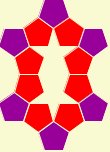 *
* 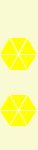 =
=  ...
... 


