Sunday, October 09, 2011

A pentagonal tree

Here is a fun tree.  The basic pattern starts with a single pentagon that branches into two smaller pentagons that in turn branch into smaller pentagons etc.  The right pentagon is dark the left is light.  This simple rule makes some interesting patterns in the tree: notably, the two lower branches that are horn like and only one colour.

I stop the shrinking at some cut off mark which preserves the leaf like appearance of the polygons. This makes the edge a little less regular and thus more tree like.  I may play around with a little with a slightly less symmetric choice for shrinking the polygons.

I may also perfect this image later so that it doesn't suffer so much from pixelation.So much to do so little time.

Wednesday, June 08, 2011

The PentHouse

This pent house was kind of fun to create.  I was stumbling around with pentagons and triangles looking for a nice pattern.  After I found this one that fills the plane, I started to playing with it in gimp (an open source photoshop knock-off) and this is what I came up with.

One of the interesting things I found out after I finished this image was that I discovered a portion of this in an ancient version of TileLand (the one on my CSD web page).  I'm still toying with a tablet version of TileLand...It's just there is so many options...

Friday, May 27, 2011

Candlesticks

This pattern  I stumbled upon when I was playing with hexagons and octagons.  After a bit of massaging, I ended up with an outline of the candlestick (here it is the white 3-layered  pattern between the stars).  In the original play, the 3 triangles were part of a hexagon that intersected with the others.  From there, I connected 6 together to make large hexagons with octagons in the corners.  I was surprised at first that I could make 3 into the triangular shape and more surprised that a small triangle exactly fit inside it.  After some thought, it made more sense.

 Image a loop of hexagons with octagonal spacers between them.  Then connect each of the hexagons with a rectangle to other hexagons from other loops.  Voila, this tiling with less decoration.  The reason for the triangle exactly fitting is a little more involved.  You have to take the loop of polygons on the left and separate the rhombus with two perpendicular lines.  The bottom perpendicular is easy--going from a 4-sided figure to an 8-sided.  The top perpendicular is trickier--going from a 12-side figure (the square and triangle make the 150 degree angle of a 12-sided polygon) to a 24-sided polygon (the 135 and the 60 of the octagon and the triangle make 195 which is the exterior angle to 165, the angle of a regular 24-sided polygon).


I'm not sure about how close the pentagons are to each other.  It looks like they touch at the vertices...  I may have to get a pencil and paper to check it out....

Wednesday, May 25, 2011

Bats

Here's a crazy tiling that reminded me of bats.  I did a bit of playing with the image to try to capture the eye a bit more. 

Essentially, this pattern is completely constructed from alternating regular heptagons and equilateral triangles.  You can scan the image and you will see there are no two heptagons that are connected by an edge and the same goes for the triangles. 

The gaps between the regular polygons resemble bats.  The bats spiral around and have two different appearances.  I find the most visually interesting spot near the centre of the spirals where it's tricky to find the pattern of the bats.  The regularity increases further from that centre.

I framed the image with one of the spiral arms. It seemed a natural choice. 

Saturday, November 27, 2010

More estimates

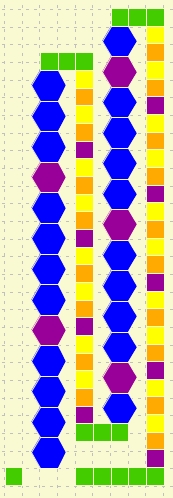
Last time, I talked about the height of a hexagon; the strategy I used works with any shape with a pair of parallel sides.  The parallel sides allow you to stack the polygons and add up the heights without having to worry about angles. For instance, it will work with a regular octagon.  The picture to the left shows 5 stacked octagons that are slightly more than 12 square (otherwise in TileLand the top purple square would be wiped out).  That means that 5 octagons > 12 squares or that  1 octagon > 12/5 =2.4 (since they are unit squares). 
For those who like to exact lengths, you can break the height of an octagon up into three pieces.  This diagram below demonstrates the breakdown: two half squares of length 1/ root 2  (since the diagonal is 1) and a rectangle with the long side of length 1.  Root 2 plus 1 is 1.41421+1 = 2.41421.   

Look forward to when I tackle odd sided polygons that don't have parallel sides.

Tuesday, November 16, 2010

Root 3

Who said approximating can't be fun?  This is an activity that I designed to get geometry students to come up with estimates for the height of a hexagon.  The tool I asked them to use was Tileland.  Tileland is a world of polygon paths (well known to those who follow this blog regularly) that doesn't allow for polygons to overlap (the top green squares replaced vertical squares that were there previously).  The following polygon path demonstrates an estimate for the height of a hexagon with unit length sides that is pretty good.  Here the height of four hexagons is slightly less than seven squares; this means that the height of one hexagon is slight less than 7/4 = 1.75.  Using the diagram of the hexagon composed of equilateral triangles and the Pythagorean Theorem, it is easy to show that the hexagon's height is actually root 3. Thus root 3 must be slightly under 1.75.  It is pretty close since root 3 is about 1.732--so within 0.02.

The reason I prefer to use types of approximations like this has to do with having a concrete physical focus to talk about.   It allows for variations and better discussions.  These two diagrams are more of the conclusions to the discussions and experiments.  Also I like reducing and/or delaying  using the magical calculator.  To me, it seems to be an ender rather than a promoter of thought.  In fact, I prefer to have students multiply 1.75 by itself to show how close it is to 3.
For better estimates, you can construct paths corresponding to these fractions 12/7, 19/11, or 26/15 fairly easily in Tileland.  To obtain 45/26, you have to use a more wiggly approach....

Thursday, October 28, 2010

Flower of Crowns

This one has an interesting centre. As it expands out it becomes clear that there are only 15 orientations of the crown pattern.  Given the nature of the centre it was clear that there it had to be a multiple of 5.    

I am still searching for a true spiral pattern that uses these crowns.  Currently I have only found things that look spiral but really have rings instead.  Perhaps, the shape is too complex.  

I guess I'll have to give it some more thought.

Popular Posts