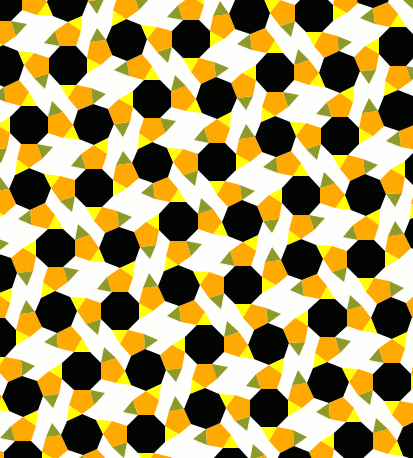
 Well there's a lot of zeds here but there are also a bunch of ens (mirror images of the zeds). This uses the same strategy as the shurikens posts. Notice between each octagon there is a pentagon and triangle inserted. In fact, this pattern is also similar to Candies--the difference is that the local connections of the octagons. Here an octagon is connected to two pentagons that are on sides 90 degrees apart whereas in Candies they are 180 degrees apart. As well, this pattern has extra olive triangles for decoration.
Monday, September 25, 2006
Catching Zeds
Well there's a lot of zeds here but there are also a bunch of ens (mirror images of the zeds). This uses the same strategy as the shurikens posts. Notice between each octagon there is a pentagon and triangle inserted. In fact, this pattern is also similar to Candies--the difference is that the local connections of the octagons. Here an octagon is connected to two pentagons that are on sides 90 degrees apart whereas in Candies they are 180 degrees apart. As well, this pattern has extra olive triangles for decoration.


Sunday, September 24, 2006
More Shurikens
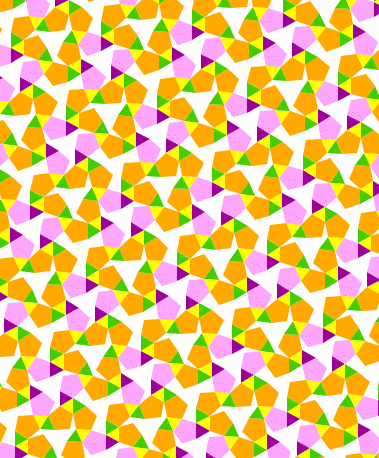 I decided that it was probably useful to add a visual explanation of the three set of Shurikens below, which can be a bit disorienting because it feels like there should be more symmetry to it than it has. Here the set with only orange and green are highlighted. The other sets have purple and pink in their colours. One has orange in the middle (the boxy shurikens) and the other has pink in the middle, which is the mirror image to the highlighted one. Another thing that is clearly shown in the image is that I need a colour consultant.
Thursday, September 21, 2006
Assorted Shurikens
 This pattern is another variation on the triangular grid (black triangles). The difference is that the polygons inserted between the triangles have less symmetry than the previous ones. Notice that there are three types of holes where the original grids vertices were--hence "assorted". I'm calling the holes shurikens because to the rotational symmetry making them look a little like throwing stars. Two sets of shurikens are mirror images of each other and the third is the one with boxy ends. I like this pattern because of the not-quite-rightness of the repeating pattern. Perhaps I'll change the border of one of the "shurikens" to a different colour to emphasize the differences...
Wednesday, September 20, 2006
Not the Zipper
 Well this is the pattern that is related to yesterday's zipper. The program to create this pattern is fairly simple. It has two different local patterns: one that looks like a propeller spinning clockwise and one that looks like a propeller spinning counter-clockwise. In the program below I have labeled them zig and zag.
zig {
sides 5
paint blue
sides 3
ifon none {
paint orange
create zag
left
create zag
} { }
}
zag {
sides 5
paint blue
left
sides 3
ifon none {
paint orange
create zig
left
create zig
} { }
}
Tuesday, September 19, 2006
Zipper
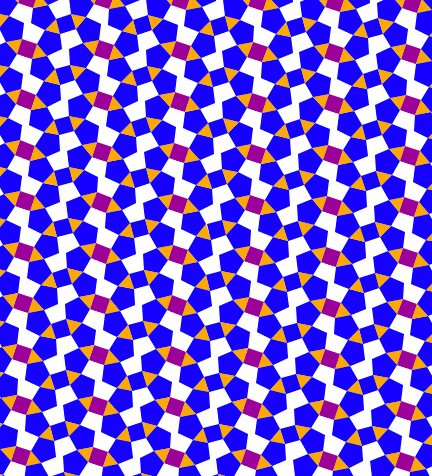 This pattern has a vertical meshing of that reminds me of a zipper. The pattern is based on a grid orange triangles, which are separated by pentagons and squares. The holes made in the middle of the triangles looks something like elongated hexagons that were sheared. The pattern looks very different when only pentagons are used. That'll be tomorrow's post.
Sunday, September 17, 2006
Swirl
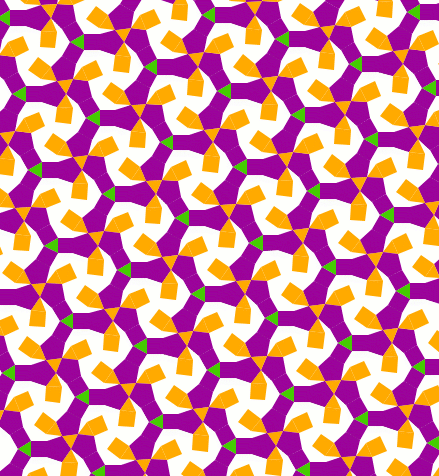 The negative space makes the swirls. The main pattern is a grid of triangles with pentagons and squares that separate the triangles. The green triangles are surrounded by triangles and the orange ones are surrounded by three pentagons. The extra triangles and squares make the swirl pattern of the holes in the middle.
Saturday, September 16, 2006
Almost
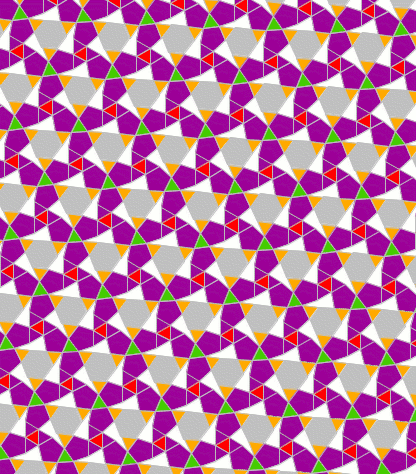 This pattern almost works. It looks like it fits together perfectly but alas the gray hexagons loosely fit. Each hexagon is connected to only one orange triangle and not touching the two. But because of the closeness it's hard to see. The way the pattern was designed from a triangular grid that had a double zig-zag of triangles and pentagons inserted between the grid triangles (red and green). Maybe it's best just to omit the misleading hexagons....
Subscribe to:
Posts (Atom)
Popular Posts
-
Here's my take on Gödel, Escher, Bach cover in an attempt to start my new class, DATA ANALYTICS: PRINCIPLES & TOOLS. These were ...
-
 This one was fun to make. I wanted a cool snowflake to be a backdrop for a presentation (http://prezi.com/jie04ey9bhjr/zulo/) that I wa...
 -
Unlike normal, I was able to deliver the square version of the descending pentagons quickly. There was no math to figure out. although ...

