 Here's another pattern that comes from a grid of octagons. It would be orange octagons and white square but the focus is on the loops of four octagons. Inserted between every pair of octagons is a triangle(red) and a square(blue). The pattern of insertion is alternating. For instance, if you follow a loop of polygons (clockwise) that surrounds a hole that resembles an S, then you will see a triangle-square that bends to the right where as the next triangle-square bends to the left. In fact, the original white squares (from a octagon&square tiling with vertex 488) are transformed into the distorted S's and Z's seen in the pattern.
Thursday, June 14, 2007
Octagons, Esses, and Zeds
Here's another pattern that comes from a grid of octagons. It would be orange octagons and white square but the focus is on the loops of four octagons. Inserted between every pair of octagons is a triangle(red) and a square(blue). The pattern of insertion is alternating. For instance, if you follow a loop of polygons (clockwise) that surrounds a hole that resembles an S, then you will see a triangle-square that bends to the right where as the next triangle-square bends to the left. In fact, the original white squares (from a octagon&square tiling with vertex 488) are transformed into the distorted S's and Z's seen in the pattern.


Wednesday, March 07, 2007
TileLand Homework
Here's some tricky homework. Figure out the types of vertices of each of these patterns. Then make a large patch of one of these patterns in TileLand. The patterns are assigned as follows : Sonya, Audriea, Kelly, Bobbi-Sue, Amanda, then Loren.


Saturday, January 27, 2007
Mixing Hexagons and Pentagons
 Here's a pattern that alternates a loop of six pentagons with the green hexagons. The loops of pentagons have two orientations. The three holes surrounded by the pentagons and hexagons are the most interesting structures to look at. I'll try to make a few variations of this pattern where I replace the hexagons with other polygons.
Friday, January 05, 2007
Unraveling a Pentagon Loop
 See if you can construct the process of unraveling a loop of six pentagons. This is a similar process to Jan. 3rd's pattern. For me, I enjoy looking at the holes in this pattern: the s-shapes and a shape similar to the "Cross of Lorraine" (the double cross). Let me know if you can construct this.
Wednesday, January 03, 2007
Unwound Heptagon Loop
 In this busy time of year, I've had a tough time attending to the blog. I get the feeling that the first part of this semester will be a bit crazy as well. So that is warning in advance. This pattern comes from a simple loop of six heptagons that are unwound by six hexagon-square pairs. As a visual explanation of this process, the picture below shows a rule that is applied to a pattern. The rule is placed the box; it shows a pair of red heptagons being replaced by a pair of heptagons with an orange square and an olive hexagon being inserted between the pair. When this rule is applied to the six instances of heptagons pairs in the adjacent loop of heptagons, the pattern on the right of the picture results. I call this process unwinding because of the angles introduced by the hexagons makes the loop go in the opposite direction. For another example of this, see July 10th's pattern.
To create the original pattern, a number of resulting unwound loop is connected in a checker board fashion and the opposite square are slightly elaborated with squares and heptagons.
Friday, December 01, 2006
Patch Quilt
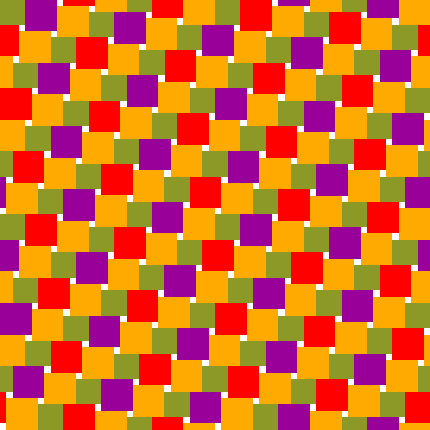 This quilt has three sizes of squares: the small white square, the medium olive square, and the rest. The pattern can take a while to understand but the colours help. Since this quilt doesn't have a four-way rotational symmetry, the program written isn't as short as I would like. When I get a little more free time I'll experiment with some more unravelling of loops. This pattern like the last is from "Tilings and Patterns".
Sunday, November 26, 2006
Tri-triangles
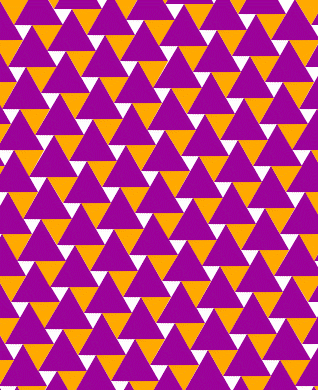 Three different triangles fitting nicely together. This one came directly out of the wonderful book Tilings and Patterns (p. 74). There are a few ones similar to this one as well that I may put up there. I'm more a fan of the patterns that come from polygon loops that are combined rather than ones like this. Still these ones are easily described since they have only one local neighbourhood. The PolygonR&D program has only one subprogram that describes the path from a purple triangle it's neighbour. The smallest triangles are not drawn since they are white.
tri {
right
scale 0.625
left
sides 3
paint orange
scale 1.6
sides 3
ifon none {
paint purple
3 { create tri
left
}
} {}
}
Subscribe to:
Posts (Atom)
Popular Posts
-
Here's my take on Gödel, Escher, Bach cover in an attempt to start my new class, DATA ANALYTICS: PRINCIPLES & TOOLS. These were ...
-
 This one was fun to make. I wanted a cool snowflake to be a backdrop for a presentation (http://prezi.com/jie04ey9bhjr/zulo/) that I wa...
 -
Unlike normal, I was able to deliver the square version of the descending pentagons quickly. There was no math to figure out. although ...

