Wednesday, September 20, 2006

Not the Zipper

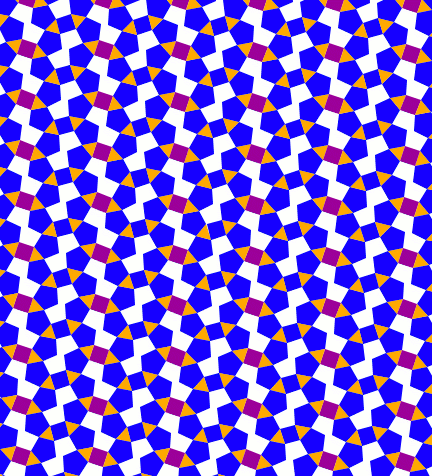
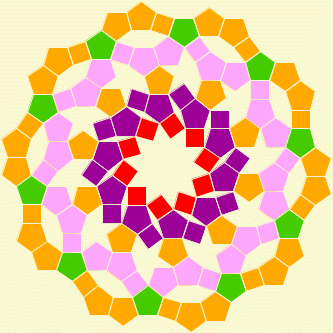
Well this is the pattern that is related to yesterday's zipper. The program to create this pattern is fairly simple. It has two different local patterns: one that looks like a propeller spinning clockwise and one that looks like a propeller spinning counter-clockwise. In the program below I have labeled them zig and zag.
zig {
sides 5
paint blue
sides 3
ifon none {
paint orange
create zag
left
create zag
} { }
}
zag {
sides 5
paint blue
left
sides 3
ifon none {
paint orange
create zig
left
create zig
} { }
}

Tuesday, September 19, 2006

Zipper

This pattern has a vertical meshing of that reminds me of a zipper. The pattern is based on a grid orange triangles, which are separated by pentagons and squares. The holes made in the middle of the triangles looks something like elongated hexagons that were sheared. The pattern looks very different when only pentagons are used. That'll be tomorrow's post.

Sunday, September 17, 2006

Swirl

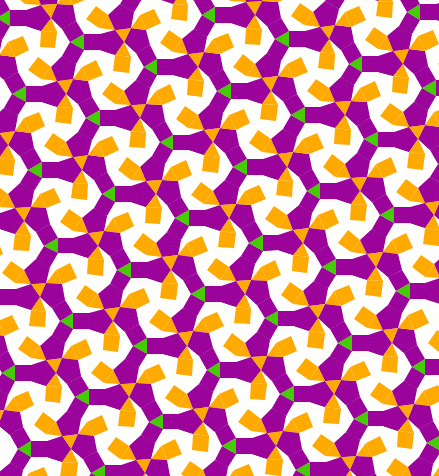
The negative space makes the swirls. The main pattern is a grid of triangles with pentagons and squares that separate the triangles. The green triangles are surrounded by triangles and the orange ones are surrounded by three pentagons. The extra triangles and squares make the swirl pattern of the holes in the middle.

Saturday, September 16, 2006

Almost

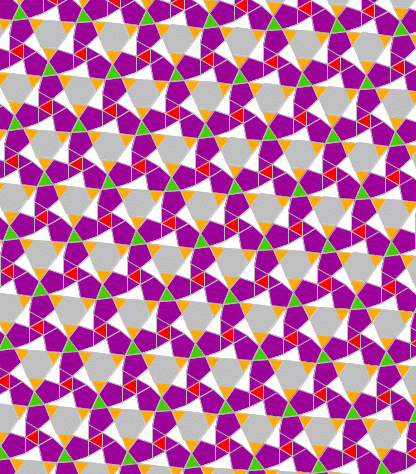
This pattern almost works. It looks like it fits together perfectly but alas the gray hexagons loosely fit. Each hexagon is connected to only one orange triangle and not touching the two. But because of the closeness it's hard to see. The way the pattern was designed from a triangular grid that had a double zig-zag of triangles and pentagons inserted between the grid triangles (red and green). Maybe it's best just to omit the misleading hexagons....

Thursday, September 14, 2006

Candies

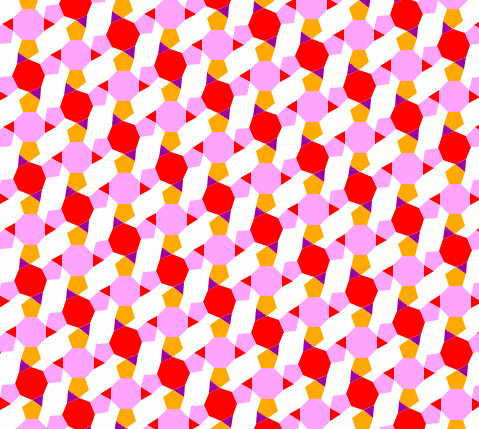
Somehow, this pattern reminds me of candies twisted in colourful wrappers. I know that I could have coloured this one better but....I was more interested in the pattern. The loops, here, have a double zig-zag pattern. The octagons are separated by pentagons and triangles in a couple of ways: pentagon with a triangle to the left (pink and red) or a pentagon with a triangle to the right (orange and purple).
As well, each octagon has two pentagons and two triangles that connect to it. I will experiment some more with this double zig-zag idea.

Tuesday, September 12, 2006

no gaps

This pattern has no gaps--most of the patterns that I have been looking at have gaps between the regular polygons. There are a number of different types of vertices in this pattern. Can you classify all the types of vertex meetings?

Sunday, September 10, 2006

Cut and Paste

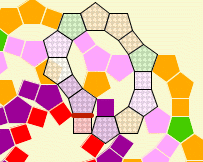
This is a TileLand design that has ten copies of a path. The path goes from one red square to the next which is a big arc. The arc has one missing pentagon between the purple square and the pink pentagon which allows for the arcs to not overlap. Below, I highlighted one of the ten arcs to make it easy to see. I probably could have coloured this one a bit better....

Popular Posts