 I'm not sure why I'm calling this a jungle. This pattern is a variant of the one on Tuesday, August 15, 2006. The pattern comes from putting a zig-zag of triangles into every loop in the original. For instance, the original has loops or six pentagons that form a rhombus hole in the middle. Here the rhombus is transformed into curved triangles (the triangle in the middle is just for decoration). On close examination, There are still only two orientations of the pentagons--half the pentagons have a vertical side.
Monday, August 28, 2006
Jungle
I'm not sure why I'm calling this a jungle. This pattern is a variant of the one on Tuesday, August 15, 2006. The pattern comes from putting a zig-zag of triangles into every loop in the original. For instance, the original has loops or six pentagons that form a rhombus hole in the middle. Here the rhombus is transformed into curved triangles (the triangle in the middle is just for decoration). On close examination, There are still only two orientations of the pentagons--half the pentagons have a vertical side.

Saturday, August 26, 2006
Birds
 Perhaps I'm being a bit optimistic that people can see birds. The gaps that are not rhombic (like a diamond) remind me of birds. In the pattern, I see these birds circling around in big spirals. The program that generates this is a very short recursive program. The pentagons alternate between gray and orange. I was a bit surprised at first that there was only alternating colours in the pattern. Even though I programmed the colours to alternate, I am really only programming the polygons to fan in a tree-like fashion. There could be many incidental connections that occur. But on further inspection, all the loops have an even number of polygons so it would be impossible to have two of the same colour. In fact, since each colour represents a particular orientation two pentagon of the same colour can't share just one edge (they would have to share all five or none).
Friday, August 25, 2006
Clover?
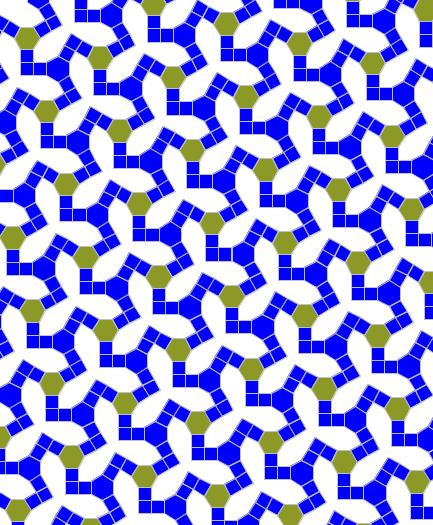 I'm calling this pattern clover because of the negative space. Looking at the polygons though, it reminds of some sort of the three legged wheel that I saw in a weird movie... This pattern was developed using a zigzag technique similar to yesterday. The three squares zig one way then the other as they go from hexagon to hexagon.
Thursday, August 24, 2006
Zigzag Grid
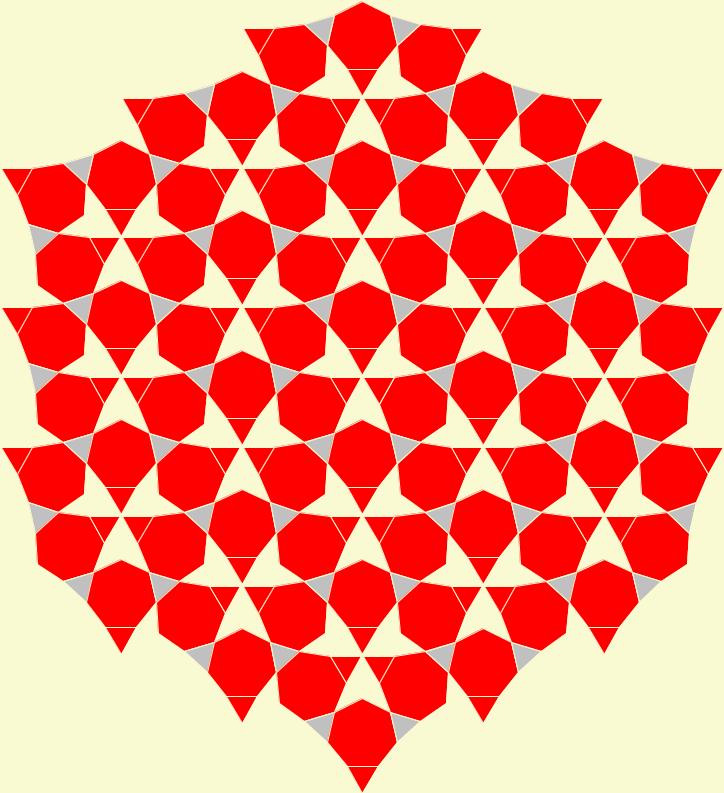 This one is not too inspired but...deal with it. It follows a similar construction to this one except the zigzagging here is with heptagons and the grid uses hexagons in the same layout as the the triangular grid (each hexagon only has edge connections with three hexagons rather than six). This is also similar to this construction. Perhaps the decorative red triangles should be a different colour....
Wednesday, August 23, 2006
bunny
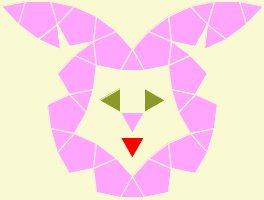 I'm bringing it down a notch. Here's a simple bunny. The only tricky thing with this pattern is that there are unseen polygons (a hexagon and two squares) used to place the eyes, nose, and mouth. See if you can make a better bunny.
Tuesday, August 22, 2006
Embellishing Octagons

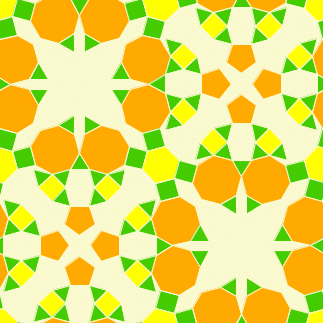
This pattern started out as a loop of octagons that was turned inside out with two loops of two hexagons, four squares (green), and two triangles. This inside-out loop served as my main loop which is the one that doesn't have the pentagons in the middle of it. After, I fit these loops together let a checker board. I filled other loops that were constructed with some yellow squares, triangles, and some pentagons.
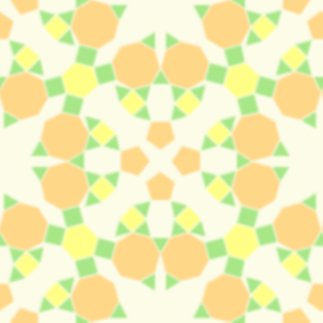
The images below can be used as wallpaper. There are links to images that are 323x323 pixels. Perhaps they would look better smaller...
Monday, August 21, 2006
Subscribe to:
Posts (Atom)
Popular Posts
-
Here's my take on Gödel, Escher, Bach cover in an attempt to start my new class, DATA ANALYTICS: PRINCIPLES & TOOLS. These were ...
-
 This one was fun to make. I wanted a cool snowflake to be a backdrop for a presentation (http://prezi.com/jie04ey9bhjr/zulo/) that I wa...
 -
Unlike normal, I was able to deliver the square version of the descending pentagons quickly. There was no math to figure out. although ...

