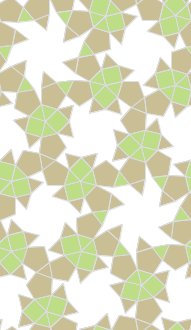
Sometimes it's the missing tiles that make things interesting. Here there are a number of missing heptagons. A missing heptagon makes each of the gentler curve between the three triangles. Including the heptagons would lead to many overlapping polygons. Perhaps there is an artful inclusion of a selection of the heptagons...
Wednesday, August 02, 2006
Sometimes it's the missing tiles that make things interesting. Here there are a number of missing heptagons. A missing heptagon makes each of the gentler curve between the three triangles. Including the heptagons would lead to many overlapping polygons. Perhaps there is an artful inclusion of a selection of the heptagons...
Tuesday, August 01, 2006
Saturday, July 15, 2006

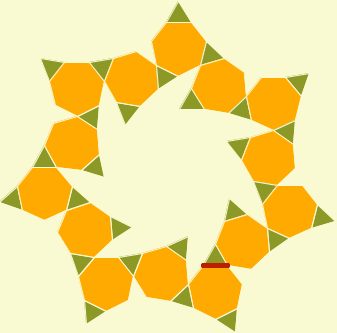
Large symmetrical loops made with pentagons make this pattern interesting. In the inner loop, there are ten pentagons with ten square spacers that outline a twenty-sided regular (all angles and sides are the same) polygon. In the outer loop, there is a thirty-sided regular polygon which can be seen as the diagonals of the grey triangular pairs.
Friday, July 14, 2006
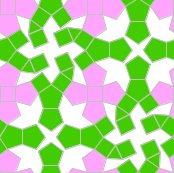
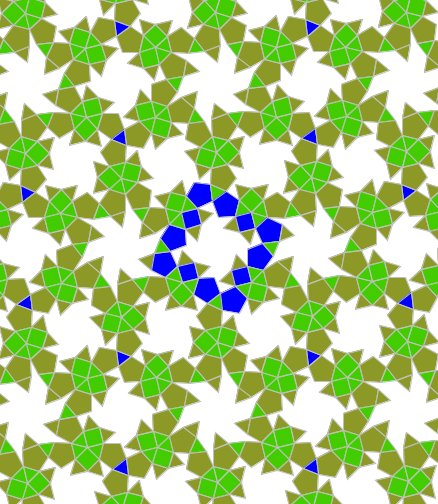
Some more play. This is based on a checker board design. The colours are not probably the best but the gaps are interesting. Like many patterns, this one started as a Tileland doodle and was later turned into a PolygonR&D program. Below I have included a larger section of the pattern to more easily see how the pattern repeats. The olive/brown polygon loop shows the basic unit for the pattern.


Thursday, July 13, 2006

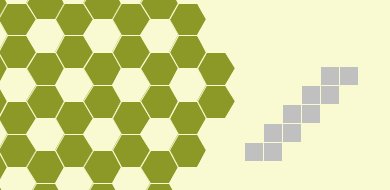
Here's a quicky. I interleaved squares into a hex grid with holes. As well, I alternated the right and left turns with the squares. The strategy is almost the same as yesterday's but now a zig-zag action is introduced to the spacers (here a square rather than a pair of pentagons) so that the orientations of the original hexagons are now altered. After two squares, the overall change in the orientation is nothing so you end up with two orientations of the hexagons. This example is much like Sunday's pattern; the hexagons and squares replace the roles of the octagons and heptagons.
Wednesday, July 12, 2006
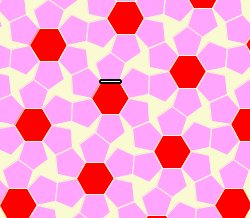
Here's a simple red hexagonal grid that has spacers inserted between the hexagons. Each spacer is composed of a pair of pink pentagons that does not effect the hexagons orientation since the connecting edges are parallel. I hope to receive some complaints about the colours :) If not, perhaps I'll litter this blog with pinks and reds! I find this approach to making patterns fun because it is difficult to predict the shape of the hole between the spacers.
Monday, July 10, 2006
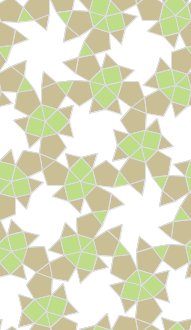 Download for tiled backdrop.
Here's a little play with pentagons, squares and triangles. There are a few ways to construct this pattern. I'll describe the process I used. I started with a
- Start with a loop of four squares.
- Add a pair of pentagons between the shared edges of the squares, this make a larger loop with a hole in the middle. The pentagons space the squares further apart.
- Add triangles in between adjoining polygons (see pictures below). This process turns the loop inside-out. Because there are twelve polygons in the loop, there are twelve new triangles added. The triangles separately form two counter-clockwise loops whereas the original loop was clockwise. The combination of the angles results in a single counter-clockwise loop. The inside of the original loop is now on the outside of the new loop.
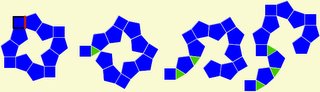
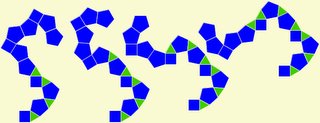

- With a bit of play, I fit the large loops together into repeating pattern. I put the large squares into something related to triangular grid. (see the last picture)
- To automate the drawing, I used PolygonR&D instead of Tileland making the process simpler and easier to modify.
- After I had the basic pattern, I decorated the pattern and selected some different colours.
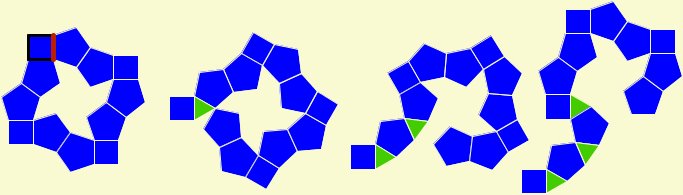

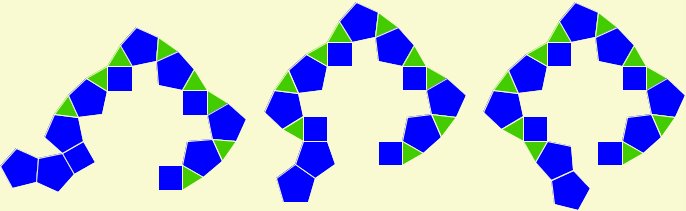
To more clearly show the constructed loop in the context of the pattern, I'm including the picture below. As well, I've highlighted important triangles to show the triangular grid.
Subscribe to:
Posts (Atom)
Popular Posts
-
Here's my take on Gödel, Escher, Bach cover in an attempt to start my new class, DATA ANALYTICS: PRINCIPLES & TOOLS. These were ...
-
 This one was fun to make. I wanted a cool snowflake to be a backdrop for a presentation (http://prezi.com/jie04ey9bhjr/zulo/) that I wa...
 -
Unlike normal, I was able to deliver the square version of the descending pentagons quickly. There was no math to figure out. although ...