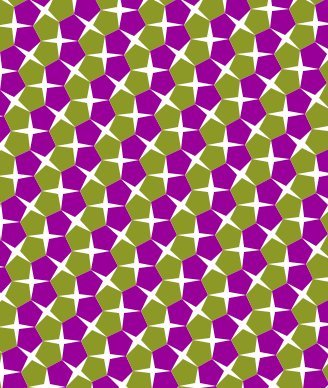
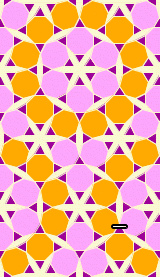
 Once again I am playing with negative space--the pattern seems more about the four-point stars than the pentagons. This pattern (with different the colouring) is on the cover of the Tilings and Patterns: An Introduction (A Series of books in the mathematical sciences) by Branko Grunbaum and G. C. Shephard which is a great book. The last couple of blog entries have convinced me to slightly augment the language of the programming language of PolygonR&D to make the programs slightly easier to write. I'll let you know if it was worth it....
Saturday, August 19, 2006
Once again I am playing with negative space--the pattern seems more about the four-point stars than the pentagons. This pattern (with different the colouring) is on the cover of the Tilings and Patterns: An Introduction (A Series of books in the mathematical sciences) by Branko Grunbaum and G. C. Shephard which is a great book. The last couple of blog entries have convinced me to slightly augment the language of the programming language of PolygonR&D to make the programs slightly easier to write. I'll let you know if it was worth it....


Friday, August 18, 2006
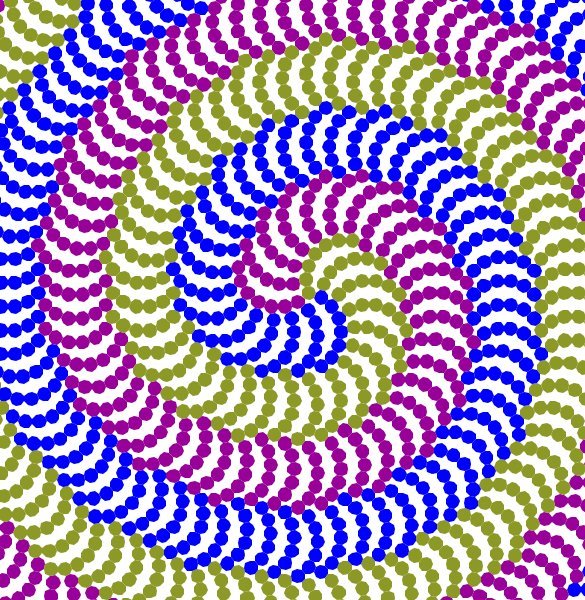 Here's another spiral. This is made with nonagons (nine-sided polygons) and has three arms. Some difference between this one and the one yesterday is that the banana-shaped gaps are bigger and they have eighteen orientations instead of fourteen. Close to the centre of the pattern like the image to the left it appears curved like a true spiral but a bigger image would reveal the eighteen-sidedness. To show that there is no trickery about the nonagons nicely fitting together there is a close up included below.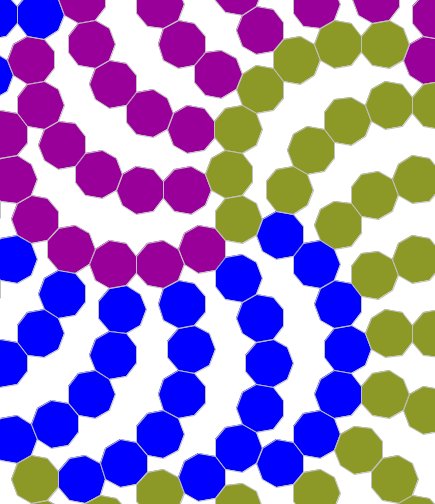
Thursday, August 17, 2006
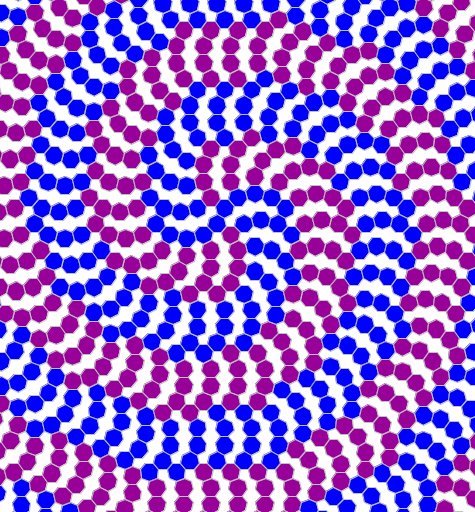 Here's a spiral pattern made of heptagons. The fours groups of banana gaps between the heptagons form the four arms of the spiral. With close examination of the gaps, one can find fourteen different orientations, which are grouped together in wedges similar to the last pattern with alternating pentagons. This pattern was created using a short PolygonR&D program (50 lines for this two colour pattern or 15 lines if it were all blue).
Tuesday, August 15, 2006
 This pattern alternates two different orientations of pentagons. The pointing up ones are blue and the pointing down ones are purple. Notice that all but one of the pentagons (the central pentagon) are connected to exactly three other pentagons. The pattern can be thought of as concentric rings of pentagons (that will approximate decagons). Another way to understand the pattern is by grouping rhombi (the white diamond slivers) in terms of orientation--there are five different orientations. The rhombi form ten wedges that meet at the central pentagon.
Monday, August 14, 2006
 This pattern is somewhat like Friday's pattern in that it uses some sections of a big loop inverted to make a loop with a star shape. The pattern alternates heptagons and triangles with the exception of the orange hexagons in the middle (heptagons didn't fit). It also has a flavour of August first's pattern since it has the same type of rotational symmetry. I prefer the August first because it offers a lot of the same interesting lines yet with a simpler design.
Sunday, August 13, 2006
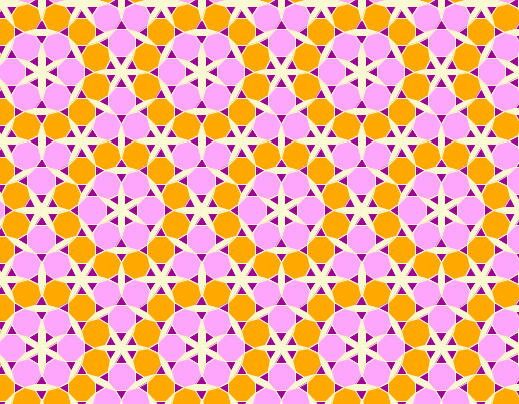
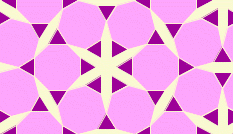
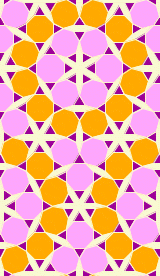 After a big battle with aesthetics, I finally settled on this pattern that makes a nice wall paper background (the image on the right). I'll highlight some of the battle. I originally started with a two colour pattern with just pink and purple. I thought it would have more impact than it did but I think with the regularity of the colouring that the pattern was dull. I added some colour it to make its bigger loops of twelve octagons and twelve triangles stand out. Even after I added orange to the mix it seemed too regular. The I introduced a twist to the pink loops of six octagons. To show you these transitions I'll added the pictures below. The key to recognizing the differences is to examine the negative space especially the asterisk like shapes. Notice there are two orientations in the pattern above as opposed to below where there is only one.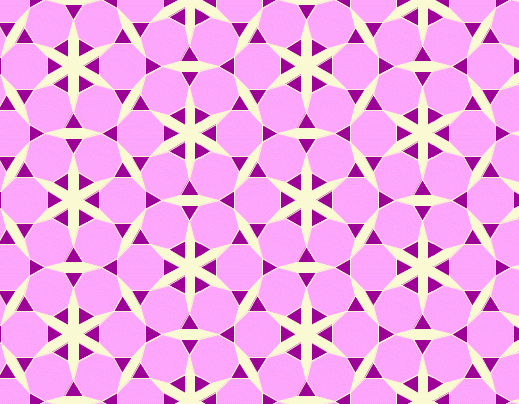

Saturday, August 12, 2006
 I guess that I've been a bit obsessed with pentagons and triangles recently. This is mostly an alternating pattern but has a couple of hexagons and triangles. I guess I like this one because of the central curved pentagon. I wish I was able to find a better way to fill the inside of the outer loop...
Subscribe to:
Posts (Atom)
Popular Posts
-
Here's my take on Gödel, Escher, Bach cover in an attempt to start my new class, DATA ANALYTICS: PRINCIPLES & TOOLS. These were ...
-
 This one was fun to make. I wanted a cool snowflake to be a backdrop for a presentation (http://prezi.com/jie04ey9bhjr/zulo/) that I wa...
 -
Unlike normal, I was able to deliver the square version of the descending pentagons quickly. There was no math to figure out. although ...

